January 08, 2011

Letter to Dad

Dear Dad,

From the beginning you have always been there for me, at times even when I wished you weren’t. I know you are having a hard time letting me go, and it shows me how much you really love me, and at times I know I will run right back to you asking for help and guidance. All I ask is that you give me a little room, but to always have the door unlocked so I can sneak back into the house for something edible.

One of the things I have always enjoyed doing with you was our “big bed time.” I remember always crawling into the big bed for our hugs and watching our shows together. I remember the Scooby Doo in the mornings while you got ready for work in the Gilbert house, then the sponge bob during dinners at your house. Those times on the big bed was always about us, we would talk about anything and everything during those long commercials, then laugh during the show.

I remember how you went to everyone of our dance and orchestra recitals, even when I knew you only went to see us, because you honestly hated watching everything else. The support you have gave me has been endless, and at times I feel as if I don’t deserve it. You have went places with me, even when I know you really did not wish to go. One of your biggest pet peeves has always asking something of you at the last moment, but as you know I tend to do that a lot. When I called you to ask to take to get my hair done for prom, you were irritated because I didn’t think of your plans, and your right. It is hard to remember that you also have a life, and it doesn’t necessarily revolve around me. Even though at times I swear it does. But even when you had plans you put it all down, and went to get my hair done, all because I asked you too.

You have been by my side through thick and thin, and I know it is the parents job to feed and shelter us, but you have loved us and supported us our whole lives, and for that I love you.

Love,

Bug

*I wrote this my senior year of high school, and recently found it. Figured I would post it. :)


January 06, 2011

Bilingual/Bicultural Education

In the early 1980’s, Sweden established the first Bilingual/Bicultural education programs. Biculturalism would be considered as the presence of two different cultures in the same country or region. This implies that there is an understanding of customs, practices, and expectations of members in a cultural group and the ability to adapt to their expectations. Bilingualism is the ability to use two very different languages fluently and successfully. Some people might be stronger when it comes to one of the languages or some people combine the two languages while talking. When people try to combine the two languages they often end up dropping signs or speaking in broken English. This is why it is better to try and stick with either one or the other.


Bilingual/Bicultural education focuses on the balance of the Deaf world and hearing world, teaching children American Sign Language as their first language and English as their second one. This gives the students an opportunity to succeed in both worlds. When a child doesn’t understand there should be an equal balance between their hearing and deaf cultures, it makes learning about one community much more difficult than the other. This type of education recognizes that English and ASL are two completely different languages just like Russian and Italian are different from one another. Deaf Culture also is discussed to teach deaf children more about themselves. This program teaches that ASL is its own language with its own specific grammar structures and rules for interaction. It also treats spoken English and written English as two separate ways of communication. This program promotes children to distinguish that Deaf culture has a common language instead of identifying themselves as deficient of hearing and spoken English. By doing Bilingual/Bicultural education it gives deaf students an advantage over other deaf individuals who learned in a different setting such as total communication, oralism, or sign writing.

Educational Institutes that follow the Bilingual/Bicultural program most often introduce this idea to children at a young age. They work with parents and family members of the deaf student to help them comprehend the special linguistic, educational and social needs of their child. This helps them realize the importance of early language acquisition. Studies show that deaf children who develop language late are less proficient than those who cultivate an early first language. The early aggression on the ability to learn grammar makes the development of a solid language compelling. However, even though many opportunities to learn these special forms of education, many parents and family members do not take advantage of the program. This is common for children who are born to hearing parents.

The Bilingual/Bicultural approach believes that deaf children are not deficient. Instead of being auditory learners, they are visual learners. This program offers a distinctive visual learning environment in which their etymological, cultural, and social needs are met. Because these children are lacking the sense of sound, it is so important to utilize all the other senses. Along with using visuals the teacher will incorporate taste, touch, and smell to help the children gain a clear understanding for each word.

A local charter school, Sequoia School for the Deaf and Hard of Hearing is a Bilingual/Bicultural school that incorporates the duel learning method as early as Kindergarten and continues to the twelfth grade. There are about seventy-five students in the Sequoia School for the Deaf and Hard of Hearing, which makes up 1/3 of the shared learning environment with the hearing students within Sequoia’s campus. There are nine educators for the deaf at Sequoia School for the Deaf and Hard of Hearing, K-12 grade. Five out of nine are Deaf, while the other four are hearing instructors. Along with each teacher there is a paraprofessional that works in the classroom. They recruit staff by posting teaching opportunities on their website. These instructional aides must be proficient in ASL to be able to help the students.

At Sequoia School for the Deaf and Hard of Hearing (S.S.D.H.H.), both deaf and hearing students are integrated allowing for both the hearing and the deaf students to have a better understanding of the opposite communities. Upon interviewing Kamilah, a kindergarten teacher at S.S.D.H.H., she told us that many of the hearing students try to learn ASL to be able to communicate with the deaf students. This allows for the deaf students to grow more comfortable when they are trying to communicate in the hearing world. We observed the children when they went to play at recess and it was fascinating watching the hearing students as they communicated with the deaf students. Even though the hearing students were not proficient in sign language, you could really see how much the deaf students appreciated the fact they were even trying to communicate in the first place. However, there was one incident that was unfavorable to one of the little boys that was deaf . He had been standing in line to go on the swings and was waiting very patiently but unfortunately the girl he had been waiting for was pretending that she could not see him. The little boy then ran over to Kamilah and started complaining about the little girl not giving him his turn on the swing that he has been waiting for. Kamilah then encouraged him to go over and confront her and tell her that it was his turn to swing. She convinced him to stand in front of the little girl and assert dominance to get on the swing. We stood and watched him go up and tell her that it was his turn. She still continued to ignore him; at this point Kamilah went over and told the girl that she was being very rude and that her behavior was inappropriate. Even though she did not know sign, she understood what he was trying to tell her. We then asked Kamilah if those kinds of incidents happened often and she went on to say that every child is different and they will all have different reactions. However, this was not something that happened very often. The fact that Kamilah encouraged the child to resolve the problem on his own showed how similar teaching is between the deaf and hearing students truly are.

The curriculum for Sequoia School for the Deaf and Hard of Hearing is the same as any public school that is based on the AZ State Standards. Heather Laine, the assistant principal and 1st and 2nd grade teacher for S.S.D.H.H. told us how they allow for certain modifications for the students acquiring their high school diploma. However, they do not allow for low grade point averages to graduate. In order to graduate they need at least a C average, which is the same for hearing students. A major difference between the deaf and hearing schools is that all deaf students are allowed to stay in school until they are the age of twenty-one. As compared to a typical hearing high school student they usually do not exceed five years. The only exception is if the hearing student is in special education. The reason for this is that 90% of children who are deaf need to learn sign language as their second language because they either have hearing parents or caregivers. As children mature, their brain organization becomes increasingly rigid. By puberty, it is largely complete. 84% of all parents of deaf students do not know any sign language at all. These students who learn language late because of their little to no contact with deaf people when they are young need more time to establish communicative competency. These statistics are very heartbreaking; unfortunately there is nothing the schools can do to change that other than by offering workshops for parents. Upon hearing Heather explain that, this made us wonder if the students ever have trouble deciphering the difference between ASL and English grammar. Surprisingly they have absolutely no problem deciphering between the two. The only other thing she mentioned about it was the fact that when the deaf students grow up they tend to not use their English grammar as much, they will write in ASL format, where as putting full sentences together with words such as is, am, were, and it.

Sequoia School for the Deaf and Hard of Hearing offers free Workshops that are provided throughout the school year for the parents or caregivers and relatives, who wish to learn ASL and MVL. MVL stands for manipulative visual language which is a technique that S.S.D.H.H. uses and is popular with other Bilingual/Bicultural education schools. This is a great program because it focuses on the visual learners, which is successful because ASL is a visual language. “S.S.D.H.H. is one of the only schools in Arizona that uses Manipulative Visual Language progressive program that teaches Deaf students the rules of English through visual input. MVL makes English grammar visual for deaf students so they can see if a sentence's structure is correct or incorrect.” This program provides a unique visual learning environment in which their linguistic, cultural, and social needs are met. These programs exist separate from the mainstream education building and agencies.

The way MVL works is they use triangles with different symbols on each one. Each symbol on the triangles stands for something different. This is how teachers can give the deaf students a better understanding of helping verbs such as, the, it, were, and am. Kamilah would have the students put each triangle in the correct order, then she would have them pick a word that applied to each particular triangle and form it into a sentence [i]. When they came up to one of the words that did not have a sign for, they would use finger spelling to complete the sentence. Kamilah told us that they continue to use this technique all the way throughout high school as well. She also told us that it is very difficult to teach the deaf students these helping verbs because there is really no solid definition for them.

It was intriguing sitting in the classroom and observing the children because even though ASL is their native language, they were very slow and still learning most of the signs that were being used in the classroom. This relates back to the fact that the majority of the students are not using ASL fluently in their households. Since young deaf children have parents that are hearing and they do not know any ASL these children have either very little to no contact with deaf people or the deaf culture. However, there was one little girl who was much more advanced than the other students. We observed her and another little boy interacting over a cute little cat watch. The little girl kept doing the sign like she was drooling over the object, yet the little boy was confused and did not know what she was saying. After Kamilah was done teaching we had the opportunity to ask her about the little girl. She then explained to us that both of the little girl’s parents were deaf and this is where she knew to use the sign like she was drooling.

We also had the chance to interview two new parents, Jed and Ann, deaf parents to deaf twins. Jed attended an oral public school without any sign language. He did not even learn English or how to read until he was in the fourth grade. He finally learned some sign language when reaching the fourth grade but just taking a basic ASL class. While Ann grew up having both deaf parents, her mom homeschooled her from kindergarten until eighthgrade. Though she just learned to read in the eighth grade, she started attending a deaf high school. This high school was grades eighth through twelfth; it was an all ASL school without any oral communication. When asked what kind of education they would like for their twin boys, Jed and Ann stated that they would wish to look into a Bilingual/Bicultural education school. The reason they gave was because it would be the best of both worlds, bring ASL and English together and such a young age would benefit their sons for their future.

There are several benefits of the Bilingual/Bicultural education. Early Access to coherent language nurtures early intellectual development. This development in turn promotes increased literacy and greater academic achievements. Pupils who attend this program are experienced in two languages. The emphasis on early language attainment and establishing a first language provides a base upon which English is consequently taught. Students in Bilingual/Bicultural education has increased self-esteem and self-assurance due to the healthy view of deaf children. They now have an acceptance of who they are as individuals and increased confidence to function in Bilingual/Bicultural environments.

Personally our group came to the mutual decision that Bilingual/Bicultural education is an amazing opportunity for deaf children to learn in a hearing and deaf community. We decided this because it allows children to grasp a better understanding of English and ASL grammar, children can integrate with both hearing and deaf children at a young age, and helping verbs can also be explained in a context that young and older deaf children can understand. The one and main thing that disappointed us about Bilingual/Bicultural education is the lack of parent involvement. If we had deaf children in the future we agreed we would all encourage our close family and friends to go learn it at one of the free workshops. For us we find that it is a hard thing to understand not wanting or being able to have communication with your child. If parents took the opportunity to learn ASL and MVL they could help their child succeed in school so much more.

January 04, 2011

Aloha Is Forever

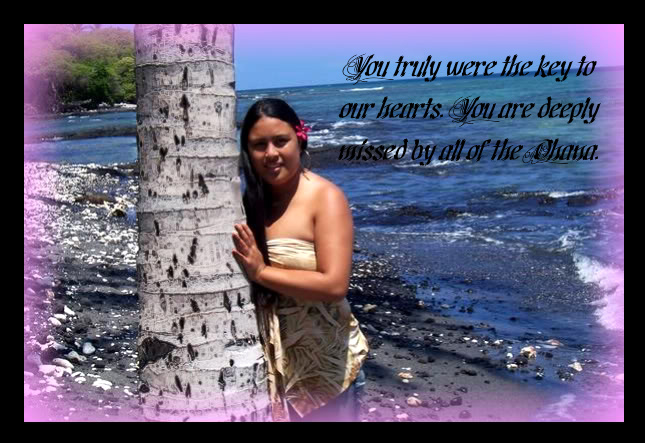
Honokaa, Hawaii is a place of wonder and beauty. During a beautiful day on June 13th 2008, a 21 year old Hawaiian girl, was diagnosed with a brain tumor. Later that day I received a phone call from Dad telling me that the results came back. She has cancer. Her name is Leihua Oliveros, and she is my cousin. Living with a cancer patient for a family member is something I could never wish on anyone. But in the last year I have learned more about life and acceptance then I have ever have before.

After hanging up with Dad I learned what Aunt Lori was not telling us. Finding out that Leihua would often black out and go blind for minutes on end was terrifying. But knowing the reason was even worse. Aunt Lori explained to us that the tumor was pushing too hard on her brain, cutting off the nerves at times. The understanding of what was going on, did not hit me until later that day-when Leihua called me. She talked as if nothing was wrong, happy and excited about going to Kona that next week. The only thing I felt that I could do was mumble an apology, “I have to go Leihua. Aloha is forever.”


For the next two weeks I would not pick up any calls from her. I spent those two weeks praying to God, asking Him to please heal her. I was mad at Him! I would ask, how could He allow this cancer to form in my sweet cousin? It was not until a friend of mine told me “God has a plan for each of his children. Maybe Leihua’s is to teach you about life, and not taking it for granted.” When he told me that, all I could do was stare at him as tears rolled down my face. Only one word escaped me, “Why?” All he did was pull me into his arms while I cried for the first time since hearing the news. That next day I called her and talked about the new things in her life. It took another week before I was able to mention the tumor to her though. I had to learn to accept the unchangeable and to believe in my faith again.

A rushed cry was heard after picking up the phone that next month. The voice on the other line was Aunt Lori telling us that a doctor in Maui, told her to get Leihua off the Islands. Flying to different islands every couple of days was not a healthy thing for Leihua, he told her. With no place on the Big Island to go for Leihua’s medical needs, it was not a safe option to stay there. At first I did not understand why Aunt Lori was panicking over moving to the mainland, but when she reminded me of the culture of Hawaii I understood. In Hawaii it is more about living in the now then the later. Meaning Leihua and her biological family were not going to take the brain tumor seriously, nor will they be willing to let Leihua move off the Islands. The fear of the consequences of Leihua not moving to the mainland were terrifying. It was not until the doctor in Maui explained to Leihua’s biological family that she will die, and fast- if she stayed there. With their blessing Aunt Lori book seats on the next plane leaving Hawaii.

We had one week to get ready. One week to sanitize the whole house so when Leihua’s immune system shut down, she would at least be safe in the house. We had to move bedrooms around so Leihua could have a separate bathroom and bedroom. When Dad told us that we had to give up our bathroom for Leihua, we were not too happy about the situation. It only took a week of Leihua using the bathroom to make us understand Dad’s wise decision. When Leihua and Aunt Lori arrived in Arizona, Leihua did not know anyone other then us. Which meant we became her constant companions. When Leihua wished to go somewhere it was my job to take her out to do it. In Leihua’s mind she was in an unknown place with a totally different culture. It was not that I minded spending time with her, it was feeling as if I had no time for myself.

The hardest thing to do is putting a smile on, when all you want to do is curl up in a ball and cry. As soon as Aunt Lori had a chance she pulled us aside to tell us to hide all bad thoughts from Leihua. We were to “keep our smiles on,” and live with the faith that Leihua’s tumor would shrink. Aunt Lori told us to, “smile when we wished to frown, and laugh when we wished to cry.” I found myself laughing a lot as Leihua’s health started to deteriorate in front of my eyes. The dizzy spells were more often now, and the numbness of the face was starting. The doctors told us that the numbness and the difficulty breathing is normal after radiation and steroids. But we still lived in fear when we could hear her breathing heavy a room away. The breathing was so bad that someone had to be with her at all times and sleep with her, just to make sure her brain would keep the breathing process happening. When Leihua started the radiation her doctors put her on steroids that made her gain an substantial amount of weight.

Watching her body change from a size 0 to 16 in such a small time was really scary. The late night talks with her crying because she did not feel like the Leihua she has always been. On top of the weight gain, she started to lose her long beautiful black hair. I thought she was upset over the weight gain, but this just threw her off. In Hawaii long hair is a major factor in the culture, and her hair was her pride and joy. Watching her cry when she held that clump of hair in her hand was something I can never forget. Her hands shook as tear after tear rolled down her face. Aunt Lori could not take another morning of watching that, so before Leihua woke up every morning I would find Aunt Lori picking up the lost hairs off the pillows.

As the calendar pages turned many things changed. Her hair started to grow back, which was a blessing in disguise because she would lose something just as important to her only days later. Leihua lost the ability to speak, barley able to breathe at times. She was heartbroken over this, after watching her struggle with writing everything down on paper we came up with something better. With the help of Leihua we made our own sign language, to help her with the basic words like eat, bathroom, sleep and etc. When we would go out, which rarely happened anymore, we became her voice because no one else could understand her. Leihua and I enjoyed our talks over ‘sign language,’ mostly because we were just messing around and making it up as we went. After losing her voice, the knees started to go out. If she did decide to use the walker, I always had to be one step behind her to catch her when she fell. Losing the ability to walk on her own, she became wheelchair bound. After my high school graduation, Leihua struggled to stand up from her chair, gave me a hug and said, “Aloha is forever. ” Hugging her, letting myself cry over the fact God allowed her to be there while I graduated, the joy I felt was indefinable. In May the doctors did not have much hope for us with Leihua’s health. Telling us to make her comfortable and have her enjoy life as much as possible. When the doctors lost hope, I went back to God.

In August everything started to change, it was like our prayers were starting to get answered. After watching and participating in Leihua’s physical therapy she seemed to be gaining strength in her legs again. Much like the excitement when a toddler takes his first steps, that is how we were when Leihua surprised us with standing up from her chair. Taking three steps forward before she asked for the chair, was an amazing feat for her. All the month of August, she took step after step wanting only to be able to walk around the house without her chair. The walking was not the only thing that happened though, her speech became more understandable. Hearing her laugh without shortness of breath after so long was an amazing sound to hear. The aloha that surrounded that room when we realized Leihua was getting stronger was amazing.

September 16th Leihua started to complain that her stomach was hurting. We just figured that she had to much of her sticky rice again. After awhile, they called Aunt Lori home to check on Leihua. She quickly determined that they needed to get her checked out, and it needed to be done now! While she was in the hospital I was in classes, but this was honestly nothing new to me. I just figured she would be home in a couple days, and that would be that. Being a cancer patient, she went to the hospital if she had a basic nose bleed for goodness sake! I received a call from Dad telling me that Leihua was being transported to the ICU because they found “something.” I knew the news was nothing good, but I figured more pills would be given, then she would be better.

Morning of September 17th I was just finishing up with my math class, when I opened a text from Dad reading, “CALL ME ASAP!” I knew from that alone it was bad news. I called him and he answered the phone crying. He told me that she was not going to make it passed the afternoon. I ran down the flight of stairs, tears smeared a crossed my face. I jumped into my car, and drove to the hospital. Within minutes I was running into the hospital, asking for Leihua Oliveros room. I ran into the room, where I was embraced by Aunt Lori. I looked over her shoulder to see Leihua. Seeing her laying on the bed, totally flat, breathing only because of the equipment by the bed- was shocking. Aunt Lori explained that Leihua was unconscious, but believed she could still hear everything going on. By 1pm, after calling all Leihua’s biological family we determined that we had to let her go.

At 3pm, we had the phones on speaker so family in Hawaii could be with us. As we were all holding onto her, they unplugged all the equipment. I still cannot believe I had enough strength for what came next. Leihua seemed as if she was waking up- lifting her arms to Aunt Lori before she took one last short breath. Her fingers immediately turned cold, as her bright black eyes became a dull gray. I stayed there for another hour before I could walk away from my cousin. When I walked away I knew that her tumor was gone, and her body healed, all while holding hands with God- and that brought me peace. I know I will never forget what Leihua brought us, the things she taught me and the joy she brought to everyone she met. Aloha truly is forever.

November 04, 2010

Who is God

Who God is, has been described in different terms since people started asking faith based questions. God has been called a great many things such as “Allah,” “Zeus,” “Akua,” and “Father” to just name a couple. But who is He really? And, am I limiting God by defining Him as a he? But most of all, I have to remember that God is more than a who, but an experience; a what. Like many people before me, I too have an explanation for who and what God is. He is the love, hope and everything that is good in the world.

God is a parental figure. His love is unconditional and I know it will never fade. He may be disappointed at times and the consequences of my actions will be dealt with by His hand. When visualizing “God the father,” I envision a child being disciplined by their dad, the hand might be firm when it hits their backside, but the hug at the end will always bring comfort and be filled with love. “God the father” brings comfort to me, not in form of a hug or a shoulder to cry on but in scripture and song. Similar to “God the father,” there is “God the teacher.” He watches, guides and strengths us in all the periods of our lifetime. He guides and provides a textbook (Holy Bible) to read. Much like a teacher guides a student to a book, it would be the students choice to pick it up and actually read it. Similar to when a student reads the Spark Note version of a textbook and barely passing the test, without actually reading the book, there will always be questions left blank. God is the father that comforts and the teacher that will continue to guide throughout one’s life.

God is when you look into a child’s eyes that is newly diagnosed with cancer. The slightest amount of fear is evident but the hope and faith of what tomorrow could bring, shines through their eyes. God is that nightlight in a child’s dark room. While the child is scared, the light will always shine. God is revealed when that same child fails to wake up. God is heartbreak and peace. Heartbreak in the knowing a child is no longer with us, but with heartbreak peace will follow. God must be a loving redeemer, because he forgives us when we walk away from Him. When a child dies the loved ones might scream and curse God, but with a prayer seeking forgiveness, it will be provided. God is a redeemer, forgiver and provider.

God is the ultimate judge, therefore leaving myself unqualified to judge other people without pointing a finger back at myself. God is the ear, that will always listen. Even when all I wish to do is hear my own voice. God is the demanding challenger, for I know, He demands only the best from me. And even at my worst he will be gracious enough to forgive me. God is living in faith that every day can be a better day. God is witnessing two old lovers kiss. God is that little piece of silence in a city filled with noise. God is shown with the kindness of a person feeding the homeless.

Honestly, God could be found in every little thing in this world. Not just the beautiful/good things but the truly ugly/bad things too. Because without ugly/bad how could one determine what was good. Who is God? God is not one thing, but in everything.

March 27, 2010

Live.Laugh.Love.Breathe Easier Eva.

Eva truly lived life to the fullest, taking the time to laugh and love more then people I actually "know." I started to read Eva's blog a couple months ago, and since than I have read every one of her posts from the begining. Through her writing, pictures, and videos I have never met a more remarkable young woman in my life.


I just found out Eva Markvoort (65_RedRoses) died at 9:30 this morning. She was a remarkable young woman who had CF (Cystic Fibrosis). She truly left a legacy behind filled with more love then people who live for 50 years, and she was only in her 20's! If you do not know about Eva you really should take the time to search 65redroses on the internet and read her blog.


Breathe Easier Eva.


December 07, 2009

The Walk For A Cure


Walking. It’s an easy task we learn at a young age. One foot in front of the other. Speed makes no difference, walking is something everyone does. We walk through life hoping the place we are going is more fulfilling then the last. We walk away from our problems and we walk right into others. Some people walk for something different. They walk for a cure. A cure for cancer. One in three people will be diagnosed with cancer during their lifetime. 1.4 million people this year alone will be diagnosed with some form of cancer. With those kind of numbers, we cannot afford to not pay attention and help with the fight against cancer.

One way anybody can help with the fight against cancer is participating in an event called Relay for Life. This event is organized by the American Cancer Society, but held in hundreds of different locations every year. I had the opportunity to participate in the Williams Campus Relay for Life during last four years. Last year however they changed it into Arizona State University Polytechnic’s Relay for Life, but most importantly it was the 25 anniversary for Relay for Life. Two summers I was asked if I would be interested in becoming Co-Chair for the upcoming year. When I questioned what that would entitle I was told I would be overseeing the Survivorship and Luminary team. When I said I would be honored to take the position I did not realize I would be overseeing my moms old co-workers and bosses. Both teams are easy and fun to work with, even with me being 20 years younger then they are, we all respect each other because we all came together for an event that has effected us all in some way or another.

Relay for Life is more then a basic walk for money. It is a 12 hour ceremony emphasizing hope and celebrating a cure for cancer. The event starts with off with the Survivors Lap, which is an extraordinary thing to be a part in. Picture over a hundred people; from the youngest at 9 months to the oldest at 98, all wearing purple shirts with the word SURVIVOR on the back. The sun is down, the luminary bags light the way around the field. Each bag has a name, they are the ones we remember. While the survivors start walking, everyone else is cheering them on, screaming and crying because while we remember the ones we lost, we celebrate with the ones that are still here, and fight back for the future generations.

Over the years of participating in Relay for Life I have been asked why I relay. Is it because of my grandfather, who has always been there for me, but for as long as I can remember has had skin cancer. Or is it for my aunt Rene, the one I never was fortunate to meet because she passed away at the age of nine, due to leukemia. Maybe my best friend, who developed skin cancer a couple years ago. Or how about my sweet cousin Leihua, who died of a brain tumor at the age of 22- just this year. I remember with Rene and Leihua, Celebrate with my grandfather and best friend, but I fight back for me and the countless others that might be that one of three people that develop some kind of cancer in our lifetime.

On April 23rd, I will put one foot in front of the other from 6 at night until 6 the next morning. I will cheer my grandfather and best friend while they walk the Survivor Lap, I will walk with my team during the Remembrance walk, and I will walk and support my team for a night of celebration, remembering and our chance to fight back.


*Since I wrote this I have become the Event Chair Of Arizona State University's Relay For Life program run through American Cancer Society

November 20, 2009

My Quest

Senior year of high school I had to write "My Quest," which is essentually just my life story. Below is the final result.

Born from two so different in mind, they searched for a name that matched their daughter’s innocence. In Hebrew, Katie means, “one that is pure of heart.” From that point on I was identified as Katie Ann. Like most children are, I was one that could not be taunted by criticism. I was that child that wiped drool from a total stranger, as they did not have the capability to do so themselves. I was that child that signed to other children who where deaf and played with them, when others thought them strange. I was that child that donated her 11 inches of hair to Locks of Love, knowing it was going to a little girl that lost her hair to cancer. I am no longer a child, but now I have started to understand the hardships of life. I am still that Katie Ann that remains pure at heart.

Only a few months of age, I was given to a 17 year old to be watched at the family clinic my grandfather owned. My mom was the one to hire her, she thought offering the job of babysitting two babies would look great on a resume for this girl. In a three day period I was shaken several times, losing a lot of my hearing and soon developed a Learning Disability. This young girl changed two people’s lives including mine, and for that my mom could not forgive herself. I regained all my hearing at the age of two with many surgeries. Being different is something I used to think was a bad thing, but over the years I learned being different was what made me who I am.

My childhood was as ordinary as it could have been. At the age of three a dress-up doll arrived in the shape of a baby sister. We grew up being called twins, but that is as far our likeness goes. As soon as we explain that we are not alike we say the same thing at the same time, creepy really. As time passed, so did the houses, dance competitions, and my parents’ divorce. Looking back I realize the divorce was for the best, but at the time I was not happy about my father leaving us. When my father left us, mom became a depressed child like person. I grew up acting much like the mom to my own mother and sister. Acting older then I was at the time made me leave the comfort of acting like a child and more as a young adult. Looking back this helped me to keep my cool in bad situations.

Like most people I am scared of certain things, for example needles and pain. A fear I developed in the 8th grade, had the possibility of death. I feared not having enough time, time to experience what life was really about. That constant fear that this thing was going to destroy everything I held dear. This thing was cancer, a six letter word that ruins lives. Those lengthy months waiting to find out if it would come back positive or negative was- terrifying. I learned I did not have it; but now four years later I find out my 21 year old sweet cousin has cancer of the brainstem. Because of its location it is not possible for them to do much of anything; all they can do is lessen the pain. The last couple of weeks I have spent more time with her then ever before, truly living and spending time with her as every day as her last.

Some might ask what strives me; the answer is to change the world. I plan to change the world one individual at a time, because that one person may possibly be the next surgeon, president, mother or father. So many live with no hope, because life has beaten them more then they could take. To give hope to others, will then give me hope that one person can make a difference. I dream of the day that I can walk into my classroom crammed with students, signing and learning how to comprehend English. To be able to teach my favorite subject to students that have a difficult time understanding English as a written language, would be a career I would love to wake up to do. I dream of the day that I become a part of the Deaf community, to better appreciate their world and language. Looking back over the years, I realize how much my life has changed. Every obstacle I have endured has made me stronger, wiser and a much better individual in itself.